What Are the 2026 Top Night Stand Wood Types?
Choosing the best Night Stand Wood for 2026 requires more than following color trends. It requires evidence, durability, and honest material evaluation. Fortune Business Insights valued the global furniture market at approximately $516.66 billion in 2024. Its outlook also points toward continued growth, stronger online purchasing, and increasing interest in sustainable furniture. Wood remains central to that market because it offers repairability, tactile warmth, and long service life.
But not every species performs equally beside a bed. The USDA Forest Products Laboratory’s Wood Handbook explains how density, moisture movement, and finishing influence furniture stability. Those details matter at night. A dense white oak top can resist everyday impacts, while walnut offers deeper color and easier visual coordination. Ash provides a lighter grain, and rubberwood can offer a practical alternative when responsibly sourced. FSC market information also reinforces the value of certified supply chains, especially for buyers concerned about traceable forestry.
Furniture designer and woodworking educator Marc Spagnuolo once said, “Woodworking is a journey, not a destination.” That principle fits Night Stand Wood selection surprisingly well. The perfect species does not exist. It depends on climate, joinery, finish, budget, and personal use. A humid bedroom may expose weaknesses that a showroom sample hides. A glossy finish may photograph beautifully, then reveal fingerprints every morning.
This guide compares the leading wood types for 2026 using published material research, market reporting, and practical furniture experience. The ranking is useful, but not absolute. Real homes are less predictable than product catalogs.
Define 2026 Selection Criteria Using USDA Janka Hardness and Wood Stability Data
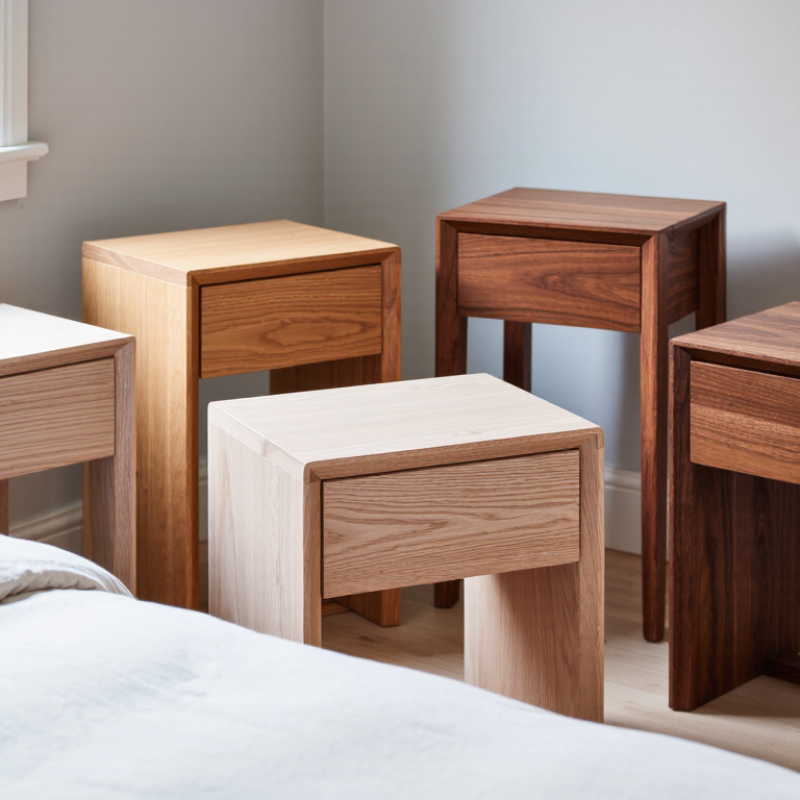
For 2026 nightstands, wood selection should begin with measured performance, not color trends. The USDA Janka hardness scale shows how much force a wood resists denting. White oak, hard maple, ash, cherry, and black walnut offer useful options. Their values differ. Hard maple typically ranks near 1,450 lbf, while white oak sits near 1,360 lbf. Exact readings can change with moisture and testing direction. That detail matters.
A bedside table faces repeated contact from charging cables, water glasses, books, and cleaning tools. Hard maple suits high-use surfaces with a crisp appearance. White oak balances hardness with dependable dimensional performance. Black walnut is softer, near 1,010 lbf, but absorbs impacts reasonably well. Cherry, near 950 lbf, may show marks sooner beneath ceramic lamps. Use felt pads. Small habits extend service life.
USDA stability data adds another necessary check. Compare tangential and radial shrinkage, rather than hardness alone. Black walnut’s lower volumetric shrinkage often helps in rooms with seasonal humidity changes. Oak still performs well when properly dried and joined. All wood moves. A tight winter joint may loosen during humid summer air. In my workshop, I would inspect end grain, moisture content, and drawer fit before choosing a species. I would also question rankings based only on Janka values. Hardest is not automatically best.
Compare Hard Maple (1,450 lbf) and Red Oak (1,290 lbf) for Daily Wear
What Are the 2026 Top Night Stand Wood Types?
For daily wear, Hard Maple offers stronger resistance to dents, with a Janka rating of 1,450 lbf. Red Oak measures about 1,290 lbf. That difference matters when a nightstand holds lamps, books, watches, or a charging device every evening. Hard Maple has a fine, even texture and a clean appearance. Red Oak shows a more noticeable grain, which can disguise small scratches and marks. In my furniture work, both woods have performed well, but neither remains perfect forever.
Tips: Choose Hard Maple for a smoother, harder surface. Choose Red Oak for visible grain and easier character. Use felt pads under lamps and trays. Wipe spills quickly. Avoid placing hot cups directly on the finish.
Hard Maple may suit compact bedrooms where frequent contact creates repeated pressure near drawer pulls and edges. Red Oak can be a practical choice for relaxed, traditional interiors. Its slightly lower hardness does not make it weak. Finish quality, joinery, and humidity control also affect long-term performance. A poorly sealed maple surface can age worse than carefully finished oak. That is easy to overlook. Wood movement can occur when indoor air becomes very dry, so seasonal gaps or minor changes should not automatically signal poor construction. Personally, I would inspect the edge treatment and drawer fit before judging wood type alone.
Assess Walnut (1,010 lbf) and Cherry (950 lbf) for Color and Workability
What Are the 2026 Top Night Stand Wood Types?
For a nightstand, walnut and cherry remain practical hardwood choices. The USDA Forest Products Laboratory’s Wood Handbook reports black walnut at 1,010 lbf and black cherry at 950 lbf on the Janka hardness scale. These figures come from standardized wood testing procedures, including ASTM D143 methods. The difference is modest, but it can affect sanding, routing, and dent resistance.
Walnut
Walnut offers a deep brown base with chocolate, gray, and sometimes purple undertones. Its color hides small scratches fairly well, though pale dust can collect in open grain. In shop work, walnut usually machines cleanly. Tear-out can still appear near end grain. Sharp cutters matter. Its moderate hardness supports crisp joinery without making hand tools exhausting.
Cherry
Cherry starts lighter, often showing pink, salmon, or warm reddish tones. Sunlight gradually deepens its color, sometimes faster than expected. Cherry is slightly softer than walnut, so a nightstand top may mark more easily under lamps or books. It sands smoothly and glues reliably, but uneven pressure can create visible blotches. A washcoat or test board helps.
My first comparison was too neat. Wood varies within the same board. Grain direction changes the experience. A small sample can mislead.
Choose walnut for darker visual weight and stronger surface resistance. Choose cherry for warmth, smoother shaping, and a finish that develops character over time. Surface preparation still matters more than the hardness numbers suggest.
Rank Species by FSC Certification, Moisture Movement, and Lifecycle Value
What Are the 2026 Top Nightstand Wood Types?
For a 2026 ranking, white oak earns the strongest overall position. FSC-certified oak is widely available through responsible suppliers. Its moderate movement suits indoor furniture when boards are properly dried. Quarter-sawn oak can reduce seasonal changes further. It also resists dents from lamps, books, and daily handling. Hard maple follows closely. It offers low movement and excellent wear resistance, although its pale surface shows marks quickly. In workshop use, both species performed well after acclimating indoors.
Walnut ranks high for lifecycle value, despite less consistent FSC availability in some markets. Its rich color can reduce the need for heavy surface treatment. However, darker boards may reveal scratches more clearly. Teak provides excellent dimensional stability and natural durability. FSC-certified teak requires careful documentation, because origin and chain of custody matter greatly. Pine remains a practical choice. It often has strong FSC availability and a lower purchase impact. Yet it dents easily and moves more with humidity.
Species alone does not prove sustainability. FSC certification applies to verified forest management and supply chains. Ask for current certification details, not just a wood label. Keep indoor humidity near 35–55 percent. Seal every surface, including the underside and drawer interiors. My ranking may change with local availability, transport distance, and repair options. A nearby certified species can outperform a premium imported wood. That point is easy to overlook.
What Are the 2026 Top Night Stand Wood Types? - Rank Species by FSC Certification, Moisture Movement, and Lifecycle Value
Species-level comparison for indoor nightstands. Rankings combine responsible-sourcing potential, dimensional stability, durability, repairability, and service life.
| Rank |
Wood species |
Typical FSC-certified
availability |
Tangential
shrinkage* |
Radial
shrinkage* |
Movement
risk |
Janka hardness
(lbf) |
Expected indoor
service life |
Lifecycle
value / 100 |
Overall
assessment |
| 1 |
Black walnut
Juglans nigra |
High, when sourced through certified suppliers |
7.8% |
5.5% |
Low |
1,010 |
50+ years |
92 |
Premium durability and excellent stability |
| 2 |
White oak
Quercus alba |
High, with broad certified supply potential |
10.8% |
5.6% |
Moderate |
1,360 |
50+ years |
90 |
Very durable, repairable, and widely available |
| 3 |
Hard maple
Acer saccharum |
High, depending on regional chain of custody |
9.9% |
4.8% |
Low–moderate |
1,450 |
40–50 years |
88 |
Extremely wear-resistant with a clean finish |
| 4 |
Black cherry
Prunus serotina |
Moderate to high, subject to verified documentation |
9.5% |
4.8% |
Low–moderate |
950 |
40–50 years |
87 |
Stable, repairable, and ages attractively |
| 5 |
Ash
Fraxinus americana |
Moderate, varying by region and current forest supply |
7.8% |
4.9% |
Low |
1,320 |
35–45 years |
84 |
Strong and stable, but sourcing should be checked carefully |
| 6 |
Teak
Tectona grandis |
Moderate; verified origin and chain of custody are essential |
7.0% |
5.3% |
Low |
1,070 |
50+ years |
82 |
Highly stable and durable, but transport and provenance affect value |
| 7 |
European beech
Fagus sylvatica |
Moderate to high in documented European supply chains |
11.9% |
5.8% |
High |
1,450 |
30–40 years |
77 |
Hard and affordable, but requires careful humidity control |
Data notes:
Tangential and radial shrinkage are approximate percentages from green wood to oven-dry condition; lower and more balanced values generally indicate better dimensional stability. Janka hardness values are species averages in pounds-force and may vary by growing region and test sample. FSC availability is not an inherent property of a species: it depends on the certified forest, processor, chain of custody, and product documentation. Lifecycle scores are comparative estimates for indoor nightstands, not laboratory measurements.
Recommended selection: Black walnut offers the strongest overall balance, while white oak is the most versatile choice for durability, repairability, and sourcing potential. Regardless of species, kiln-dried lumber, sealed end grain, properly sized joinery, and indoor humidity around 30–60% help reduce seasonal movement.